
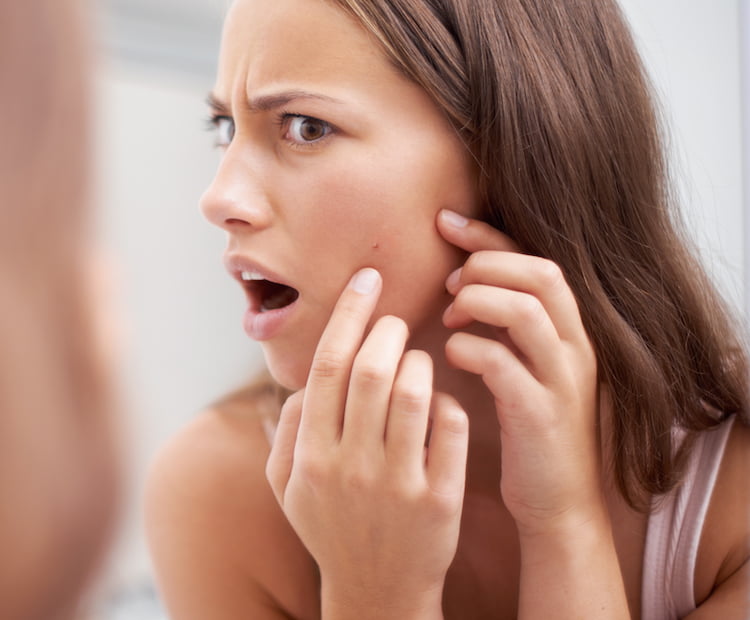
Too often when it comes to skin care, we can’t catch a break—just a breakout. Acne looks different on everyone, but the ever-present whiteheads and blackheads remain the same. Is it bad karma, bad skin care or just a few bad habits? Where do they come from, and what can we do to treat them? We sat down with Lauren Hartman, MS, PA-C, a skin care expert from the Warmuth Institute of Dermatology, to talk about the differences and similarities between whiteheads and blackheads and the treatment of each one.
What’s the Difference Between Whiteheads and Blackheads?
Hartman tells us that acne is a self-limited disease that involves the sebaceous follicles and is considered to be one of the most common skin conditions in the United States. It can be found on the face, chest, back, upper arms and shoulders. More commonly, it appears in the form of either whiteheads or blackheads. So what does that mean? “Acne lesions are characterized as inflammatory or noninflammatory,” says Hartman. “The non-inflammatory lesions are called comedones, which can be open or closed.”
Whiteheads
Categorized as the “closed comedones”—whiteheads are generally pale in color, slightly elevated and can be more difficult to detect. The pore becomes clogged beneath the skin, so it is important to avoid squeezing or popping a whitehead as it will break the protective layer of skin, increasing the risk of scarring.
Blackheads
Categorized as the “open comedones”—blackheads are slightly raised or flat with a dark follicle filled with lipids and keratin. Because blackheads are open and exposed to the air, the color changes to a dark gray or “black.” Blackheads are extremely common and can be even harder to extract without proper exfoliation two to three times a week.
Causes of Whiteheads and Blackheads
According to Hartman, the primary cause of acne itself is unknown, but she shared that there are several factors believed to influence it.
Also Read: How to Get Rid of a Cold Sore, Fast