To the skin was impeccable, you need to look after it in 24/7 mode. And remember: all efforts will be in vain if cosmetics do not match the type of skin. We will help to determine it.
Characteristics of skin types
The type of skin is laid genetically, but its features can vary during life under the influence of different circumstances:
- hormonal changes during puberty, pregnancy, during menopause;
- with a sharp change in climate;
- under the influence of lifestyle and eating habits, including harmful ones;
- as a result of stress, which most of us do not even notice.
Observe the condition of your skin and focus on its condition, choosing the means of care.
How to determine the condition of the skin at the moment? Clean your face, sit in front of the mirror and consider your reflection.
Normal Skin
There are no obvious drawbacks:
- color – homogeneous, relief – smooth;
- the texture of the skin is matte, with a light glow.
Dry skin
Even with the naked eye you can see that it is delicate and delicate, it practically does not see the pores. Up to a certain age, beautiful porcelain skin without a single pimple is an obvious advantage.
But do not delude yourself. Dry skin is often sensitive, as it lacks lipids that prevent the evaporation of moisture from the surface of the epidermis.

The skin can be dry, oily, normal, combined.
Under the influence of climatic factors or improperly selected cosmetics, it is easily dehydrated and begins to peel off, provoking a feeling of tightness.
In addition, dry skin fades faster, doctors even have a characteristic of this type of aging – fine-wrinkled.
Oily skin
The skin of a fatty type looks dense, and even without a magnifying mirror, it is easy to see enlarged pores and black dots. Her eternal companions:
- excessive shine;
- uneven texture;
- earthy complexion;
- rashes that often become inflamed.
Oily skin paradoxically also happens dehydrated and even sensitive, especially with aggressive care, that is, the abuse of alcohol tonic, scrubs, agents with acids and retinol.
All these imperfections are paid off with one big plus: oily skin is aging much more slowly and is not prone to the formation of premature wrinkles.
Combined skin
This is the most common type, combining signs of oily skin in the T-zone (nose, forehead, chin) and dry or normal in the U-zone (cheekbones and cheeks). Care for such skin should also be combined, the main thing – to choose the right means for each site of the face.
Sensitive skin
Sensitive, that is poorly protected from aggressive environmental factors, can be any type of skin – dry, oily, normal or combination.
A characteristic sign of sensitive skin is an acute reaction to a change of climate or cosmetics, new food, stress, alcohol: face turns red, chin and cheeks may appear itchy and dry.

During life, not the type, but the skin condition changes.
Skin type test
Still in doubt, what exactly is your skin type? Try to honestly assess her condition.
A
- Skin is matte, without greasy shine.
- Feelings of tightness after washing are not present.
- Acne and inflammation do not bother.
- After walking, the facial skin does not turn red.
B
- There is no acne.
- Often after washing, there is a feeling of tightness.
- For some foods, the skin reacts with redness.
- After a long stay in the sun or in the wind, the skin begins to peel off.
AT
- Acne and black spots are your constant companions.
- You have already tried all methods of combating greasy shine, but to no avail.
- Extended pores are visible to the naked eye.
- After cleansing, the skin starts to shine.
D
- Skin on cheeks, temples and around the eyes often flakes.
- On the forehead, nose and chin are black dots.
- In the T-zone, a greasy shine is observed.
- Once a month, or even more often on the chin, nose and forehead there are pimples.
If you answered yes to most questions:
- in block A – you have a normal skin type.
- in block B – you have a dry type of skin.
- in block B – you have a fatty skin type.
- in block D – you have a combined skin type.
How to determine the type of skin beauticians
An experienced cosmetologist is able to determine the type of your skin visually, but still will ask several questions. Additional digital diagnostics, for example, video-dermatoscopy, consists of examining the skin under a large magnification in order to carefully consider the texture of the skin, the condition of the pores, the pigment spots, the invisible microsilicon. With the help of various attachments, you can even measure the degree of greasiness and dehydration.

The cosmetologist can determine the type of skin visually and with the help of dermatoscopy. © iStock
How cosmetics affects the skin
Doctors are unanimous: with regular use, well-chosen cosmetics can correct the problems that are typical for any skin type. For example, reduce the production of fat and matte fatty skin, and in the case of dry skin – form a protective hydro-lipid film and eliminate discomfort.
When choosing cosmetics, it is important to focus on two parameters:
- texture of the product: for the oily skin, light non-comedogenic products are suitable, for dry – saturated, providing comfort;
- active components: they are responsible for the declared result.
Care for different skin types
Properly selected cosmetics can reduce discomfort and temporarily improve the appearance of the skin or completely eliminate the problem.
Normal
Neither extended pores, nor comedones, nor acne – it’s no wonder that girls with normal skin often refer to withdrawal lightly. And completely in vain. To save a gift of nature, do not neglect the basic rules of care. Choose funds marked “for normal skin.”

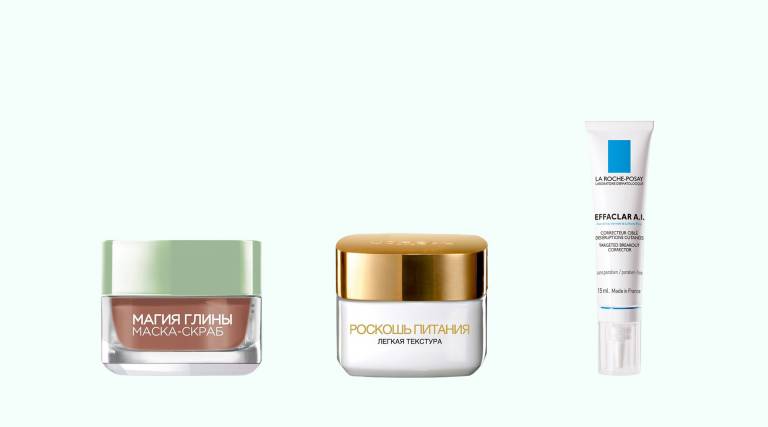
Cosmetics for normal skin
Dry
Owners of dry skin should use caution with agents with acids and retinol, they can cause irritation and discomfort. Moisturizing and nourishing – that’s what dry skin needs.
- Use a cream with SPF-filters 365 days a year, because UVA-rays have harmful effects regardless of weather conditions. Clouds and glass for them is not a barrier.
- On the package with cream, look for the label “hypoallergenic”.
- At night it is better to use a cream with pronounced lipid-restoring properties.
- For a deep cleansing of the skin, use delicate exfoliants.

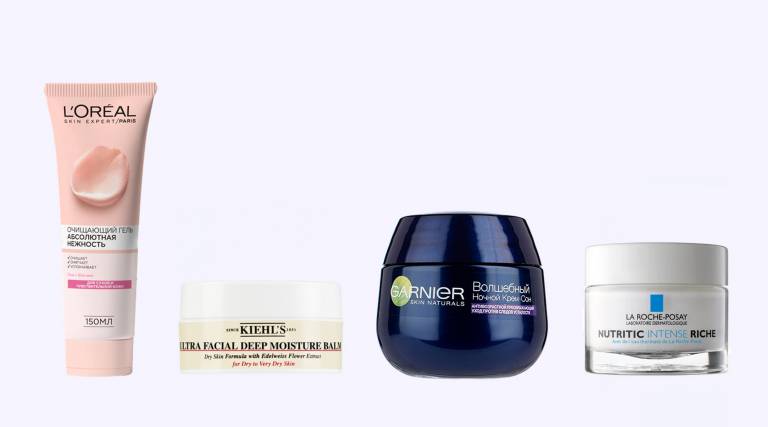
Cosmetics for dry skin
Oily
Choosing an effective remedy for oily skin, remember that it needs funds marked “non-medogenous.” It is extremely cautious to use products with oils.

Cosmetics for oily skin
Combined
When choosing a remedy for combination skin, note that the T-zone is usually oily, with enlarged pores, and the cheeks and the area around the eyes are prone to dryness.
- You need funds labeled “for combination skin.”
- It is worth using combined moisturizing: for dry areas, a rich moisturizing cream is suitable, for fatty – light gel or fluid.