
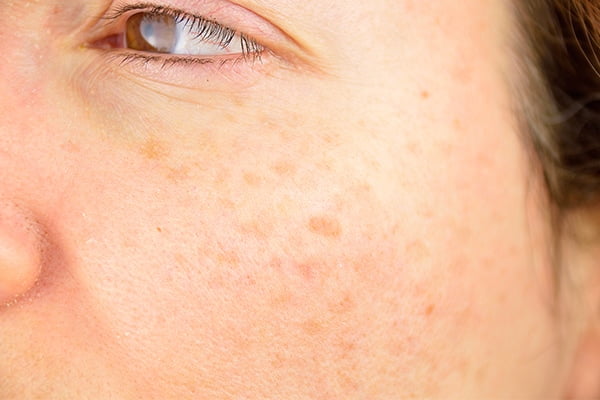
Age spots are flat and oval areas of tan, brown, or black color on the surface of your skin. These spots are caused by excess production of melanin, which can lead to the accumulation of melanin in the keratinocytes (epidermal skin cells).
Also known as liver spots or solar lentigines, age spots can give an uneven appearance to your skin complexion.
Although associated with progressing age as a critical factor, age spots can develop as a result of damage caused by prolonged exposure to the sun.[1] The increased production of melanin induced by UV light accumulates and takes the form of an age spot.
Although age spots are painless and harmless, they are undesirable.
Causes of Age Spots
The possible causes behind developing age spots are:
- Exposure to sunlight (UV radiation), resulting in excess production of melanin that can lead to a darker skin tone
- Aging of skin in people older than 50
- Excessive use of tanning lamps and tanning beds
People with a fair or light complexion are also likely to develop this condition.
The Appearance of Age Spots
Age spots appear on the skin as:
- Flat, circular to oval markings of intense pigmentation
- Tanned to black colored
- Painless[1]
- Located on areas with maximum exposure to the sun, such as the face, shoulder, upper back, back of the hands, and top of the feet
Treating Age Spots
Age spots are painless and do not pose any health risks. However, for cosmetic reasons, a considerable amount of time and expenses is spent on procedures that, though effective at times, come with a range of side effects.
There are some standard medical prescriptions and procedures for treating age spots. Read more